Advanced Guide
This guide introduces advanced concepts that are implemented in EvSpikeSim.
Table of Contents
Spike Buffers
In EvSpikeSim, neurons are processed in parallel. Therefore, post-synaptic spikes need to be stored in buffers during the inference. If the buffer of a neuron becomes full, all buffers are processed into the post-synaptic spike array and the inference is resumed. However, there is no known method to predict the number of post-synaptic spikes that will be fired by a neuron. These buffers thus have a fixed size of 64 (floats) per neuron by default. The size of the buffer impacts both the memory usage and the performance. Large buffers use more memory but require fewer inference iterations than small buffers which can slow down simulations. When creating a layer, you can specify the size of the spike buffer to use.
EvSpikeSim C++
In EvSpikeSim C++, this is done by giving setting the last argument of the add_layer method:
unsigned int buffer_size = 32;
std::shared_ptr<sim::FCLayer> layer = net.add_layer<sim::FCLayer>(n_inputs, n_neurons, tau_s, threshold, init, buffer_size);
EvSpikeSim Python
In EvSpikeSim C++, this is done by giving setting the buffer_size argument:
net.add_fc_layer(n_inputs=100, n_neurons=1000, tau_s=0.010, threshold=0.1, initializer=init, buffer_size=32)
Eligibility Traces
Eligibility traces are temporal records of past events that are essential for learning. They are typically represented by ordinary differential equations of the form:
When a post-synaptic or pre-synaptic events occur, alterations of eligibility traces can take place. For example the following update can be performed when an event occur at a time \(t^\prime\):
The trace decays with a time constant :math:tau, which results in a fading memory of the past activity, where greater importance is given to recent events over those that occurred farther in the past.
Therefore, an eligibility trace updated with the previous example would corresponds to a simple low-pass filter of past events, such as:
The following figure illustrates the behavior of this trace.
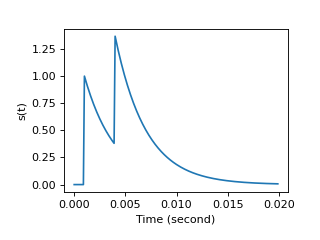
An example of a simple low-pass filter eligibility trace with a time constant of 3ms receiving two events at times 1ms and 4ms.
Eligibility Traces Template
In EvSpikeSim, eligibility traces and their behavior are defined in external C++ files (.cpp) that are compiled when creating layers. The default template for a source file is the following:
#include <evspikesim/Layers/EligibilityTraces.h>

namespace sim = EvSpikeSim;

sim::vector<float> sim::synaptic_traces_tau(float tau_s, float tau) {
    return {};
}

sim::vector<float> sim::neuron_traces_tau(float tau) {
    return {};
}

CALLBACK void sim::on_pre_neuron(float weight, float *neuron_traces) {

}

CALLBACK void sim::on_pre_synapse(float weight, const float *neuron_traces, float *synaptic_traces) {

}

CALLBACK void sim::on_post_neuron(float *neuron_traces) {

}

CALLBACK void sim::on_post_synapse(float weight, const float *neuron_traces, float *synaptic_traces) {

}
Note
The CALLBACK decorator needs to be added in front of the on_pre_neuron, on_pre_synapse,
on_post_neuron and on_post_synapse callback functions. It allows cross-compatibility for both CPU and GPU
implementations.
The following sections describe how to define eligibility traces and their behavior using these functions, and explain how to create layers using source files.
Define Eligibility Traces
Eligibility traces are present at two levels in neurons:
at the synapse level (i.e. synaptic traces)
at the neuron level (i.e. neuron traces).
The two functions synaptic_traces_tau and neuron_traces_tau are used to define the time constants of traces at the synaptic and neuron levels, respectively. These functions must return vectors of time constants in second.
The number of time constants returned by each function defines the number of eligibility traces that will be created at each corresponding level. For example, the following example creates two traces per synapse and a single eligibility trace per neuron:
sim::vector<float> sim::synaptic_traces_tau(float tau_s, float tau) {
    return {1.1 * tau, INFINITY};
}

sim::vector<float> sim::neuron_traces_tau(float tau) {
    return {0.9 * tau};
}
The tau_s and tau arguments are the synaptic and membrane time constants that are given when creating a layer.
You can use them, as in this example, to create traces time constants that are relative to the neuron model time
constants.
Note
INFINITY is used to disable decay. Traces with an infinite time constant act as non-leaky integrators and can
be used to accumulate information.
Update Eligibility Traces
Traces can be updated and locally interact with each other when events occur. More precisely, a neuron trace can be updated:
when a pre-synaptic spike is received at any of the neuron’s synapse, using the
on_pre_neuroncallback functionwhen a post-synaptic spike is fired by the neuron, using the
on_post_neuroncallback function.
On the other hand, synaptic traces can be updated:
when a pre-synaptic spike is received at the same synapse, using the
on_pre_synapsecallback functionwhen a post-synaptic spike is fired by the neuron, using the
on_post_synapsecallback function.
Note
The decay of traces is internally managed by the simulator.
The order in which the callback are called respect the direction of propagation of the information. When a pre-synaptic
spike occurs, decay is first applied to the eligibiliity traces, the on_pre_synapse is called for the corresponding
synapse of the neuron, then the on_pre_neuron is called for the neuron that received the spike. The order of call at
pre-synaptic events is summarized in the following diagram:
![digraph {
rankdir="LR";
"Pre-synaptic spike" -> "Traces decay" -> "on_pre_synapse" -> "on_pre_neuron";
"Pre-synaptic spike"[shape=polygon, sides=4, fontsize=11]
"Traces decay"[shape=polygon, sides=4, fontsize=11]
"on_pre_synapse"[shape=polygon, sides=4, fontsize=11]
"on_pre_neuron"[shape=polygon, sides=4, fontsize=11]
}](_images/graphviz-68cfb525d3f78f8c7807df63bab64f6dfd630384.png)
When a post-synaptic spike is fired by a neuron, decay is first applied to the eligibiliity traces,
the on_post_neuron is called for the neuron that fired the spike, then on_post_synapse` is called
for every synapse of the neuron. The order of call at post-synaptic events is summarized in the following diagram:
![digraph {
rankdir="LR";
"Post-synaptic spike" -> "Traces decay" -> "on_post_neuron" -> "on_post_synapse (all)";
"Post-synaptic spike"[shape=polygon, sides=4, fontsize=11]
"Traces decay"[shape=polygon, sides=4, fontsize=11]
"on_post_neuron"[shape=polygon, sides=4, fontsize=11]
"on_post_synapse (all)"[shape=polygon, sides=4, fontsize=11]
}](_images/graphviz-73a0b78825148c39d7c8cef9c1f0b39aee3475ea.png)
in the next sub-sections, we describe how to use each update callback.
on_pre_synapse
The on_pre_synapse function receives three arguments:
the weight of the synapse that received the pre-synaptic spike
the (immutable) neuron traces
the traces of the synapse that received the spike.
For example, the following callback updates the second trace of the synapse with the first trace of the neuron, scaled by the weight:
CALLBACK void sim::on_pre_synapse(float weight, const float *neuron_traces, float *synaptic_traces) {
    synaptic_traces[1] += weight * neuron_traces[0];
}
on_pre_neuron
The on_pre_neuron function receives two arguments:
the weight of the synapse that received the pre-synaptic spike
the neuron traces.
The following example callback updates the first neuron trace by integrating the weight of the synapse that received the spike:
CALLBACK void sim::on_pre_neuron(float weight, float *neuron_traces) {
    neuron_traces[0] += weight;
}
on_post_synapse
The on_post_synapse function receives three arguments:
the weight of the synapse that is being updated
the (immutable) neuron traces
the traces of the synapse that is being udpated
Note
Note that, unlike on_pre_synapse, the on_post_synapse callback is called for every synapse at
each post-synaptic event.
For example, the following callback updates the second trace of the synapse with the first trace of the neuron, scaled by the weight:
CALLBACK void sim::on_post_synapse(float weight, const float *neuron_traces, float *synaptic_traces) {
    synaptic_traces[1] += weight * neuron_traces[0];
}
on_post_neuron
The on_post_neuron function only receives the neuron traces as argument.
The following callback example increases the first neuron trace when a post-synaptic spike occurs:
CALLBACK void sim::on_post_neuron(float *neuron_traces) {
    neuron_traces[0] += 1.0;
}
Warning
Keep in mind that these callbacks functions are called every times an event occurs. Try to keep these functions as simple as possible to avoid any computational overhead that would slow down simulations.
Full Example: Spike Time-Dependant Plasticity (STDP)
In Spike Time-Dependant Plasticity (STDP), the strength of a synapse is modified based on the timing of the spikes. If the pre-synaptic neuron fires just before the post-synaptic neuron, the strength of the synapse is increased. Conversely, if the post-synaptic neuron fires just before the pre-synaptic neuron, the strength of the synapse is decreased.
Formally, the change of weight \(\Delta w_{i,j}\) induced by STDP between the pre-synaptic neuron \(j\) and the post-synaptic neuron \(i\) is defined as a sum over all pre-synaptic and post-synaptic spike times, such as:
where
This kernel induces Long Term Potentiation (LTP) with an amplitude \(a_{\text{pre}}\) when a pre-synaptic spike occurs before a post-synaptic spike. If a pre-synaptic spike occurs after a post-synaptic spike, Long Term Depression (LTD) is induced with an amplitude \(a_{\text{post}}\). Here, \(\tau_{\text{pre}}\) and \(\tau_{\text{post}}\) represent the time constants of the LTP and LTD respectively. The following figure illustrates the behavior of this kernel as a function of the temporal difference between pre-synaptic and post-synaptic spikes:
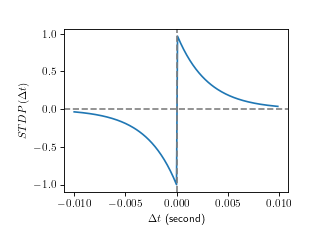
Long Term Potentiation (LTP) and Long Term Depression (LTD) induced by STDP.
To implement STDP with eligibility traces, we need to define one neuron trace \(s_{\text{post}}(t)\) that keeps track of the post-synaptic activity and two synaptic traces \(s_{\text{pre}}(t)\) and \(\Delta w(t)\) that respectively keeps track of the pre-synaptic activity and the changes of weight.
These traces have the following linear dynamics:
When a pre-synaptic spike occurs, the traces are updated as follows:
And when a post-synaptic spike is fired by the neuron:
Using our template of callbacks, STDP is implemented as:
#include <evspikesim/Layers/EligibilityTraces.h>

namespace sim = EvSpikeSim;

static constexpr float a_pre = 1.0;
static constexpr float a_post = 1.0;

sim::vector<float> sim::synaptic_traces_tau(float tau_s, float tau) {
    return {tau, INFINITY};
}

sim::vector<float> sim::neuron_traces_tau(float tau) {
    return {tau};
}

CALLBACK void sim::on_pre_neuron(float weight, float *neuron_traces) {

}

CALLBACK void sim::on_pre_synapse(float weight, const float *neuron_traces, float *synaptic_traces) {
    synaptic_traces[0] += a_pre;
    synaptic_traces[1] -= neuron_traces[0];
}

CALLBACK void sim::on_post_neuron(float *neuron_traces) {
    neuron_traces[0] += a_post;
}

CALLBACK void sim::on_post_synapse(float weight, const float *neuron_traces, float *synaptic_traces) {
    synaptic_traces[1] += synaptic_traces[0];
}
Create a Layer with Eligibility Traces
Now that we have defined our eligibility traces, we can create layers with them. When creating a layer, EvSpikeSim will compile the given source file and load it as a dynamic library. If the file has already been loaded, EvSpikeSim will skip the compilation.
EvSpikeSim C++
In EvSpikeSim C++, layers with eligibility traces are created as follows:
std::shared_ptr<sim::FCLayer> layer = network.add_layer_from_source<FCLayer>("path/to/source/file.cpp", n_inputs, n_neurons, tau_s, threshold, init, buffer_size);
EvSpikeSim Python
In EvSpikeSim Python, layers with eligibility traces are created as follows:
layer = network.add_fc_layer_from_source("path/to/source/file.cpp", n_inputs, n_neurons, tau_s, threshold, init, buffer_size)
Access Eligibility Traces
After inference, eligibility traces are available. Their values correspond to their last update (i.e. last event that occured).
EvSpikeSim C++
In EvSpikeSim C++, eligibility traces are accessed as follows:
const sim::vector<float> &neuron_traces = layer->get_neuron_traces();
const sim::vector<float> &synaptic_traces = layer->get_synaptic_traces();
EvSpikeSim Python
In EvSpikeSim Python, eligibility traces are accessed as follows:
neuron_traces = layer.neuron_traces
synaptic_traces = layer.synaptic_traces
Random and Reproducibility
To allow reeproducibility, it is possible to set the seed of random generators.
EvSpikeSim C++
In EvSpikeSim C++, this can be done by providing the seed at the construction of a RandomGenerator object:
unsigned long seed = 42;
sim::RandomGenerator gen(seed);
EvSpikeSim Python
In EvSpikeSim Python, the random generator used by initializers is global. To set its seed, proceed as follows:
seed = 42
sim.random.set_seed(seed)